Friday, May 05, 2006

He walked the walk.

I've got only one day to go before I take off and I still have a hell of a lot to do. I've become acutely aware of how much time this I've been sitting in front of my computer working on this blog or sticking my foot in my mouth on the jazz forum. I am surprised how beguiling this blogging is. Perhaps that's one reason for its popularity.

I am not a succinct writer and will endeavour to use many words when only a few will suffice. I also take quite a bit of time rereading before I hit the "Publish Post" button. At least with this blogging system, I can edit or even remove the post days after the fact.

It all adds up to many hours spent at my computer, when I could be doing other things, like practising or packing.

Yet I feel compelled to finish off writing about my previous times at Banff before I go there again. I believe that way I can shorten my daily blogging time, without having to explain something that previously transpired up there.

In 2003, I believe the guest artist was originally slated to be Palle Mikkelborg, who collaborated with Miles on his mid-80's recording of Aura. For whatever reason, he couldn't make it and Rufus Reid got the call.

Everyone knows what a great bassist Rufus is. What is lesser known is that in recent years, he turned his talents and experiences toward composition and was pursuing it with all of his vigour.

Not surprisingly, he approached his writing from a rhythmic and groove-based perspective. I didn't consider his writing style to be particularly radical or ground-breaking, but it certainly was challenging and fun to play.

I introduced myself to Rufus with one of my typical smartass lines that I immediately wished I could have taken back. I told him that the last album I heard him play on started off with a nasal voice saying "One, two, one, two, three, four". Rufus did a bang-on Jamie Aebersold impression. I stood there fearing what sort of first impression I made on him.

For some bizarre reason, I ended up in the lead tenor chair that year. I'm more comfortable in the 2nd tenor or bari chair, but Banff is not about comfort.

It was a joy to watch Rufus put the rhythm section through their paces. It was the section he knew intimately and he worked them partcularly hard. He would explain the tempo and groove to them, then give them one chance to get it right, because that's the way it works in the real world. Rufus has this cool way of telegraphing how he wanted the tune to feel, by the sort of little walk he would take before counting it in. He'd move in time; the funkier the tune, the funkier he would move.

I worked hard to do as good a job as I could in the lead tenor chair. When I messed up key passages, Rufus was hard on me. I particularly remember a section in his arrangement of Round Midnight. He took a bass solo and then at the bridge, I had a lead line that would bring the band back in. Typical of me, in rehearsal, I got really caught up in listening to his wonderful soloing and then I'd muff my part. After the second time it happened, he wasn't too impressed with me. We didn't have a lot of time to rehearse this piece and I swore I would come in the right place in concert.

Come the performance, I was focussed. There was no way I would miss that entry, goddamit and I didn't. The only thing was that without telling the band, Rufus had decided to extend his solo. Most people picked up on it, but I had tunnel vision and came in anyways. I recall that someone in the rhythm section also started in, but I got the stare from him, one that was pretty obvious to the audience. There was another instance in that first set where I was supposed to come in and he cut me off after a couple of notes.

I was pretty pissed off at the break because I felt he was singling me out. But it didn't take me long for me to realize that this wasn't the case. Sometimes it just a simple matter of realizing that in performance the bandleader is always right. I was just being really anal in my rendering of the charts. He was making changes on the fly and I wasn't keeping up to some of them. I was over it by the end of the gig - another lesson learned.

After the gig he was very gracious and he autographed one of his bass books that I swiped from a bassist friend of mine before I left for Banff. I loved returning the book with Rufus' signature in it. At the end of the year, Rufus e-mailed me a New Years greeting, which I really appreciated.

That year, in order to accomodate Rufus' schedule, the guest artist segment came first in the program. Next were a few days of working on the original compositions, followed by Hugh working up repertoire for the final concert.

I made good on my rash offer the previous year to bring a piece of mine up there. With Hugh's blessing, I had written a pretty avante-garde piece with a full colour graphic score. It was modular in nature, with a set introduction and conclusion and four interchangeable modules that comprised the bulk of the piece. Each module was basically a set of rules for the band to follow and three of them had solo passages. Each module was based on a concept that I had developed out of the New Orchestra Workshop improv series, and the overall architecture of the piece was heavily influenced by my brief experience with Barry Guy.

Each module had a different image as part of it, each being a different colour. I had cue cards with each of these images which I used to tell the band which module to move to. The images were photograms that were created by my close friend Mia Weinberg, who had done an extended visual arts residency at Banff the previous year. I'm sticking an excerpt of my score onto this posting.

It was an ambitious piece and I workshopped it with my regular rehearsal big band back in Vancouver. They had rarely played anything much more contemporary than Thad Jones/Mel Lewis charts, and frankly my efforts with them were a pretty dismal failure.

So I was nervous presenting the piece to all of the very fine jazz players in Banff. I didn't know what they would make of it, but they ended up doing a brilliant job of it. Many of the people in the band had never played anything that out, but they all went for it. That's just the way it is at Banff. The orchestra ended up doing a fantastic job of it for our final concert. Hugh asked if I would be willing to donate the original score to the music library at Banff, which I gladly did.

I left the place in a daze, with the realization that I had just become a composer. That was my huge achievement for 2003.

My other achievement that year was on a totally different level. It's a really intense environment up there and musicians have different ways of blowing off steam. Of course a lot of time is spent in the pub and that leads to a lot of crazy stuff.

Every year, the now-legendary stories of what VEJI pulled off in the eighties would be told, probably getting a little better in the retelling every time. I dare not repeat any here.

There were tons of practical jokes being pulled by certain members of our orchestra that year. Things ranged from the ever-popular water in the trumpet joke to the dreaded deadly fart during rehearsal. Yeah, it was sophomoric, but way fun. It started getting a little out of hand between lead altoist Kent Sangster and trumpeter Mike Herriott.

Mike is a brilliant lead player and has chops for days. He's worked damned hard to be that good and he demands a lot of the players around him. I've come to really respect that. He's also capable of being very abrasive, especially if you are not pulling your weight. He's certainly forced me to raise my level of playing.

He and Kent go way back and they were really were going after each other with the jokes. A lot of what they did must be filed in the "What goes on in Banff, stays in Banff" category. Slowly some of the rest of us were getting pulled into their pranks. Naturally, I have to back up my section leader, and besides Mike was asking for it, just for being Mike.

A few days before the final concert, Kent, second altoist Olivia Tischler and I came up with an evil masterplan to get Mike once and for all. We were going to get him in the middle of my piece during the final concert. It was a sign of how far gone we were that I was ready to jeopardize a couple of months work on my first major composition, just to do this prank. I cleared it with Hugh a couple of days prior to the show. He was in in a heartbeat.

Now here is the spoiler. I am not going to describe the joke in detail. What goes on in Banff... The most I will say is that it involved something downloaded off of Mike's website and a bit of Photoshop trickery. In the days before the final concert, Kent and Olivia and I could not look at each other without cracking up.

I will say that in concert the joke went off without a hitch. It pretty well brought the whole orchestra to a stop in the middle of my piece. Kent turned around to take pictures of Mike's reaction, and Hugh can be heard on the concert recording taunting him. Mike was furious and he screeched out some notes on his trumpet, but since my piece was so "out", there was no way he could ruin it. I think I even gestured to him to keep going.

After the show, Mike was livid with me. He demanded that all evidence of the joke be destroyed and that I never circulate copies, ever. I promised to do so and I've kept my word. He swore retribution, and since he may well be reading this blog, that may be coming this year.

Hell, it was worth it. Getting my composition in the library was an honour, but creating the practical joke of the year was the icing on the cake.

Thursday, May 04, 2006

Inside / Outside

I have no misconceptions about my abilities as a jazz saxophone player. I could name dozens of people in Vancouver who can play circles around me in a straight-ahead setting. As a ferinstance, last Saturday night, after Phil Dwyer's outstanding performance with the Hard Rubber Orchestra, I was speaking with Eli Bennett. He'd recently come back from playing in LA for one of the official Grammy Awards all-star bands, and will be opening for McCoy Tyner on June 30 at the Ottawa Jazz Festival. He is the real deal and he hasn't yet graduated from high school.

I inhabit a musical netherworld with one foot lodged in straight-ahead playing and the other more firmly planted in improvised music. Few sax players here in Vancouver hang their shingle out there. IMHO, Saul Berson and Graham Ord do it most successfully. Francois Houle obliterates all boundaries, but he's exclusively a clarinettist now. Coat Cook has some mean R&B chops, which he puts to good use, but his forte is new music. Dave Say can play anything, but the main body of his work is on the more straight-ahead side of things. Danny Kane had a rep for many years as the absolute wildman of the bari sax. Not as well known is that he has some of the most killing straight-ahead chops of anyone in town. His notoriety overshadowed that and for many years, he could not get enough straight-up paying work, partially due to that rep. The last time we spoke, he was shying away from doing any new improv projects that would reinforce that image.

This is the niche that I have chosen to place myself in, as I have been drawn to more progressive and avante-garde forms of music ever since my teens. My formal studies have always been in classical or standard jazz styles and I have been studying with Stan Karp for over 10 years. He's arguably the best saxophone teacher in Western Canada, one of the very best on the West Coast, steeped in the traditions of his mentors Bill Green, Buddy Collette and Joe Henderson. I consider him to be a dear friend and inspiration - I owe him a huge debt of gratitude.

Also over the last 10 years I have taken countless workshops in improvised music, many thanks to the tireless efforts of Coat Cooke in particular, Ron Samworth and the New Orchestra Workshop Society. I was a participant in the 2005 Vancouver Creative Music Institute with stellar new music figures such as the brilliant George Lewis, Mark Dresser, Nicole Mitchell and Mwata Bowden, the latter two being prominent members of Chicago's famed AACM. The highlight of VCMI for me was the opportunity to spend several days with Evan Parker, where I endeavoured to absorb as much I possibly could. Evan was extremely generous and gracious during our time together.

That all being said, I consider myself on the very long and slow track to mastering my instrument. I never was a young lion like Eli, and it's getting past the time for me to be an old lion. I just keep moving ahead down that long road at my own pace. I still feel like I get a tiny, tiny bit better every time I play and I hope it always is that way in my life. Now and then I hit the turbo and zoom down the road for a stretch. The programs at Banff are turbochargers goosed with anabolic steroids.

The road isn't without its bumps and in the raw emotional atmosphere at Banff, one is particularly vulnerable. I really felt I was playing way over my ability that first year at Banff. My insecurity had been gnawing a little at me, saying I was a fraud for presuming that I was good enough for the likes of Hugh Fraser and Maria Schneider, but frankly I was too damn busy just keeping afloat rather than listening to that particular voice.

After the final concert of Maria's works, we had a final blowout party and jam session at the Music and Sound Building. The air was tinged with melancholy because the program was over and some people will have departed before most of the rest of us woke the next day to deal with our hangovers.

I had said my final goodbyes and had actually walked out the door when one of those aforementioned innocuous remarks hit me in the gut hard.

I've debated internally whether or not to post who said it or what was said, and on reflection, it really doesn't matter. It was just one of those smartass remarks in the vein of "Don't let the door hit your ass on the way out." Said between old friends, it's really nothing.

What was important was how I handled it, not well, as it turned out. I took it as a harsh judgement of my playing abilities, and that little voice of negativity in my head broke loose. I was a total fraud, I dragged the orchestra down, I only got invited to Banff because I was a friend of Lorae's who could afford to go at the last minute, everybody hated me, blah, blah, blah. This ate at me all that night and for weeks to come. It certainly took the shine off of the whole experience.

It took me a long time to come to terms with my insecurities. Lorae and Hugh, my wife Clara, Stan Karp and others were very supportive, but it was something I had to put to rest myself. I now think that part of it was just a self-generated reaction against the quantum leap that I had just taken. I also had the realization that the comment was a way of reminding me that the outside world is not always a very nice place.

Hugh has put enourmous energy over the years into creating an inclusive, open and positive atmosphere at his programs in Banff. It is in a drop-dead gorgeous physical location and the facilities are superb. The food is a topic for another posting. It's very easy to create a perception of the Banff Centre being a bubble of perfection, isolated from the rest of the world. You get the urge to cocoon yourself up there forever and never go back.

Hugh does take time at the end of every program to talk about integrating yourself back into the real world and strategies for carrying on the spirit of what transpired in the program. I just never expected to have my bubble burst to suddenly.

But yeah, the real world is full of disappointment, asshole club owners, indifferent audiences and jaded, judgemental musicians, Revenue Canada, etc., so deal with it. And model yourself in in way that you really want to live. Pursue your dreams. Live in integrity. Enjoy yourself. Surround yourself with like-minded people. Give and receive love.

It took me a while to get my head around all of this. In the end, it was one of the two great insights that I had. The first was that I was actually capable of being involved in the creation of music at the highest level. The second was that life has a way of throwing unexpected curveballs, but it's how I deal with it that really counts. That was the more important of the two lessons.

As for the person who made that remark, our relationship had a few more twists and turns, and now I am honoured to consider him a friend.

Wednesday, May 03, 2006


Maria, Maria.


I can't really go on any farther without writing about my experience with the guest artist that first year I went to Banff. If there was only one thing that I would be allowed to remember about that time, it would have to be those few days Maria Schneider spent with us.

There was a fairly palpable sense of anticipation in the days leading up to her taking the helm. Pianist Michelle Grégoire for one, seemed be counting down the minutes, despite really digging what was going on with the rest of the workshop. We had performed some of Michelle's compositions that I thought were just great, in fact I'm listening to our performance of them as I write this. I recall hanging out with some of the band in Michelle's room and she was keeping a couple of Maria's cds on her night table in anticipation of working with her.

Maria was already there, spending her time in one of the artists' cabins, doing some composing. She had been the guest artist the previous year and there were some repeat participants in the orchestra, ready to pick up where they had left off.

On the first day, she told us some of her background, particularly her experiences with mentors Gil Evans and Bob Brookmeyer, then we started working through some of her charts. It was some of most challenging music I had ever played. The only thing that rivalled it was working up a performance of Barry Guy's Witch Gong Game II/10 - a huge graphic score of exquisite beauty and torture.

It struck me immediately how Maria's arranging broke down the standard blocky sectional style of arranging. It felt like there were 20 separate lines weaving together. Often nobody else in the sax section was playing my phrases, the connections would be weaving all over the orchestra. You really had to be listening to everyone else all the time. And there always was a propulsive sense of forward motion in every single line she wrote, even if there were separated notes spaced over several bars. This is very evident in Gil Evans' writing and Maria insisted each of us play that way, shaping and moving every phrase.

Her ears are huge. She seemed to hear everything all the time. It felt like she picked up on every clam I hit. No matter how complex the music was getting, if I forgot to shape a phrase, as she was turning and conducting, she would catch my eye. And everybody was feeling this same way.

Once we got to the point where she felt we had enough music for the concert, she really worked the band over. I was in heaven, and totally overwhelmed. I was spending every free minute I could practicing, and would stay in the practice room past 2:00am, until I started falling asleep with my horn in my mouth.

Then there was the matter of doubles. In her own orchestra in New York, most of the sax section doubles on everything imaginable, including oboe, english horn, bass flute and basset horn. She would have written for a contrabass sarrusaphone if some in the band had one.

I was switching between second tenor sax and bari sax. Calgarian Keith Krushel (of Swinging Bovines Sax Quartet fame) and I found it advantageous to switch chairs on different charts. We shared my flute. I hadn't brought my bari, just my mouthpiece, but a brand new top of the line Yamaha bari had been brough up from Calgary. It was a sweet horn.

I ended up with the bass clarinet parts - I must have lost the coin toss. The music department had also brought up a beautiful brand new Selmer model 65 low C. They don't get any better than that unless you are a misguided Buffet snob. I later learned from Francois Houle that he was the very first person to have played it there, brand spanking new, and I would have been the second. I would have dearly loved to have been able to take that fabulous instrument home with me.

The problem was that I really couldn't play it. To that point in my life, I had prided myself that I had never as much as played one note on a regular clarinet. I played a little bass clarinet in Vancouver with the Douglas College Nite Band, but it was almost all goose eggs, very simple stuff. Now here I was playing the most fiendishly difficult and beautiful music I could ever have imagined, in front of the composer, who just happened to have the hearing acuity of a bat.

I practised the thing every moment I could. I knew I had a fantastic instrument in my hands, the only thing lacking was me. Even though I have no problems playing my bass sax, a low C bass clarinet requires a particularly long extension of your right arm to cover the keys properly. After only a couple of hours, it really got to hurt, and by performance time, my arm was killing me. I tried every position possible and very little relief was achieved.

But by this time I was completely in Maria's thrall and would have gladly drunk the proverbial Jonestown Kool-Aid, had she asked. I played through the growing pain and practised every waking hour that I had free.

One day, between sessions, Maria grabbed me as I walked by the main rehearsal hall. She would tell anybody who cared to listen that she was not much of a pianist. But here she was, almost beside herself with excitement. She said, "Listen to this!". She was sight-reading a Hindemith piano sonata (or was it a concerto?), which she had found in Banff's extensive music library, something she had been searching for for years. She was reading this down pretty damn well in my opinion, AND analyzing it on the fly. "Listen to how this chord works with this one!" She was in heaven, was soaking it all in, and had to share that moment with someone. I was the lucky stiff passing by.

Two pieces in that concert program stand out for me. The first was her new suite Three Romances, which later showed up on her Grammy-winning album Concert in the Garden. The first movement, Choro Dancado is achingly beautiful and is one of my favourite pieces to this day. The bass clarinet part is quite challenging and it took everything I had to pull it off. I resolved that I would never get stuck in this position again, that I had to learn my doubles. Last year, I decided to forego attending Banff and instead bought a bass clarinet of my own, an instrument that I now love to play pain-free.

This movement also required one of the percussionists to play a pandeiro, which is the Brazilian take on a tambourine, but so much more. It intrigued me enough to search one out when I got back home. I eventually took pandeiro lessons with the phenomenal Celso Machado, so I have Maria to thank for that as well.

To be honest, I can't remember playing a note of the second movement, Pas de Deux. I can't even tell you what instrument I played. All I can remember was that it was the only easy piece in the whole program, mostly backgrounds to an extended solo.

The third movement is also very lovely, Danca Illusoria. It was another very challenging piece of music to play.

The other composition of hers that remains in my heart was the centrepiece of the evening, Hang Gliding, a brilliant piece she wrote about her experience of riding a hang glider over Rio de Janeiro. For starters, it was in 11/8, about 13 minutes long and almost totally through-composed. No convenient repeats, no Basie-like sectional work, always original, and pushing everyone in the orchestra. I was playing the Yamaha bari and recall there was a passage with a high G in the middle of a beautiful moving line. Seeing as how the natural range of my Selmer horn stops at high F, this was going to be a challenge. I have never seen a high G written in the hundreds of other bari charts that I've played over the years. I'll be honest - in the end I scuffled through that passage, close but no cigar.

But the real challenge for me was a passage towards the very end of the piece, where the bari sax had the lead in a line that led to the final climax of the piece. Maria was on my case about that passage - it was crucial and had to be played cleanly yet with a lot of emotion. I was having trouble with it right up to the final rehearsal. It was only in the very final rehearsal that the piece really came together as a whole, and she started dancing while we played. I immediately got extremely emotional. Bill Mahar and Kent Sangster played brilliant solos, and by the time I got to that crucial passage, I had a lump in my throat and tears in my eyes, not particularly primo sax technique, but I got through it, and played it pretty well the way she wanted.

Here I was in the best band I had ever played in, with some of the finest musicians in the country, playing the most gorgeous and difficult music imaginable, and being led by this beautiful and amazingly talented woman. I was so grateful to Hugh and Lorae for having invited me up there, something I couldn't have imagined only 5 days earlier. It was too much to bear.

The rehearsal wound up after we finished that piece, and I hung back to talk with her. I was still so choked up that I really couldn't communicate that well. She initially thought I was upset about that passage, but I eventually got across my deepest and profoundest gratitude for having the privelege of sharing those days with her.

I could not listen to the opening bars of Hang Gliding for months afterward without getting a lump in my throat. That rehearsal was the very day that my life as a musician irrevocably changed. There was no going back.

If you haven't done so, please visit Maria's website, one of the better musician's websites in my opinion. You can hear some samples of her music on the home page, just turn up your speakers.

At the top of the page is a picture of the two of us backstage on the night of the concert. You can find more at Michelle Grégoire's website. Michelle was also one of our orchestra who was deeply affected by her time with Maria.

We were living in a state of grace.
Da rules

Thanks to Brian Nation for the shout out today and for encouraging me to write my daily scree. The Vancouver Jazz website is fantastic and a great asset to our community. I lurked for a long time on the forum and started posting there more frequently this year. I always enjoy the blogs by Cory, Morgs, Brian, Josie (come back to town!) and my former bandmate Mr. Doheney. We've gotta get one of those N'awlins-type handles for John, say Étoufée or Warmdaddy. He's probably got one but won't tell any of us Yankees, because it's something like Flatass.

I figured my jaunt up to the Rockies would be a perfect excuse for a blog. I have a need to document my thoughts, but it will remain to be seen if anyone else finds them of interest.

It's my plan to load up on postings before I head out at that ungodly hour this Saturday morning. I want to deal with some of my history with the place beforehand so that I can be more in the moment with my missives up there. I hope to post daily, but I cannot guarantee that I will always be coherent or sober.

DISCLAIMER This blog is a work of fiction, rather, at the very least it's reality strongly filtered through through the semi-functional mind of one ertswhile musician. All characters and events portrayed in this work are fictional, but no names will be changed. Any similarity to what is about to transpire at the Banff Centre is purely coincidental, though cosmically preordained.

There, my ass is covered. I've been thinking about this whole blogging process, since I know some of this year's workshop participants regularly visit vancouverjazz.com. At this point I feel the only honest thing to do is to write what is on my mind and stay respectful of other peoples' own processes while they are here. If my blog has any negative effect on the proceedings up there, I will have to reconsider continuing with it. I guess I could have done it anonymously, but that's a copout.

I want to thank Patrick Dubois for his support. Patrick is an extraordinarily gifted pianist who did the Banff program with Chucho Valdes many years ago. He has written two very orignal and entertaining treatises on the topic of clave, stemming from that experience. He also lent me some Irakere cds, since just like Maria Schneider, I am not really familiar with Chucho's work. (I can hear Alan Johnston tsk-tsking...) The first one I listened to was "Live at Ronnie Scott's". As the cd played, I was thinking that this was killer stuff, but doable from a horn player's viewpoint, and thank God I don't have to play the piano part - bonne chance, Marianne!

Then I flipped on the next two cd's in the car. What the hell is that? That shit is IMPOSSIBLE!!! There was stuff that I initially thought was programmed synth because it was just too damn fast, but noooo, it's the saxophones playing this endless staccato line at breakneck speed, dead clean. And what about that flute soli? I'm really in for it. The soloist are dropping more jazz quotes than your basic Doheney solo. Ohmygawd. I guess I'll be tossed into the deep end whether I like it or not.

I'd have it no other way.

Tuesday, May 02, 2006

Out of the blue

Without the support of my family, particularly my wife Clara, no amount of determination on my part would enable me to take these trips. She has always been incredibly supportive of my musical endeavours. Particularly with Banff, she has always encouraged me to go, even when our finances have been tight. We find a way to make it work with Cassandra's school and activity schedules. It's a wonderful thing to have such support, to be able to go up there without a guilty conscience.

She was the one who immediately asked "Well, what's to think about?" when I got that very first call from Lorae Farrell almost exactly four years ago to this day. Lorae is a longtime friend, former bandmate and the better half of Hugh Fraser (some may argue she's the better 90%). She told me there was a last-minute opening for the bari sax chair at the Banff workshop due to start in a few days. Hugh had remembered me from a workshop he had run the previous fall, just after the two of them had started dating. Lorae said that Maria Schneider was the guest artist and I just had to get my ass up there, and bring all my doubles.

So, with Clara's blessing I basically dropped everything and hopped a plane to Calgary, without a clue as to what I was getting into. Some of my friends had been to Banff in previous years and had spoken well of it. I was aware the program had changed somewhat, but had no details.

I really had no idea who Maria Schneider was, never having listened to any of her cds nor having played any of her charts. I must have seen something about her on television because when we met, I realized I was familiar with her appearance and her habit of breaking into dance when the music was really happening. It was either TV or a prescient dream - late at night the distinction blurs.

I was completely unprepared for those 10 days to totally change my life as a musician.

For the sake of brevity, I will try to limit my recounting of that first time up there, but there were a number of highlights, and there were some cases where a few words casually tossed off had big consequences.

The very first day of the program, Hugh started off with an exercise in communal music making that was passed to him by master African drummer Abraham Adzenyah years earlier at Banff. I had done the basic version of it in Hugh's workshop in Vancouver the previous fall, so I was mildly competent with it. This time, Hugh advanced it several more steps, until almost nobody could do it. Then he told us it was a Ghanaian kid's game. It had the effect of levelling the playing field with all of the participants, got everyone involved and was a hoot. It was all done away from our instruments, then Hugh got us to play and it became an incredible piece of music. It was a brilliant way to get a large group of strangers to gel into a musical ensemble in a couple of hours.

I made some great friends that year. There's a common bond that all of the participants have, a special shared experience that will last for a long time. Among others were Michelle Gregoire, the wonderful Winnipeg pianist; flautist Jeremy Price from London, ON, now Vancouver; trombonist Steve Mynett also from Vancouver; and sax section leader Kent Sangster, a mainstay of the Edmonton scene.

There was a trumpeter from Montreal who freaked me out the first couple of days. The first time we met he walked straight up to me and said "You're Steve Bagnell from Nova Scotia". Uhhh-huuhh... Later that day he asked "You used to play in Track." Yeah.... The next day it was "Your mother's name is Shirley." I was getting a little freaked at this point, and I was wondering if he knew my SIN number and that I was late in filing my taxes. It turns out that he is married to my second cousin and that they were originally from Halifax. He had joined the long running horn band "Track" just after I moved to Vancouver. Bill Mahar is a superb trumpeter and composer, and his wife Jennifer Bell is a killer sax player. They are fixtures in the Montreal jazz scene. They have been coming to Banff for many, many years and I always look forward to playing with them again. Too bad that neither of them can make it this year.

When these sorts of synergistic coincidences happen, I pay attention. I knew the second I arrived at the Banff Centre that it was a special place, but that cinched the deal.

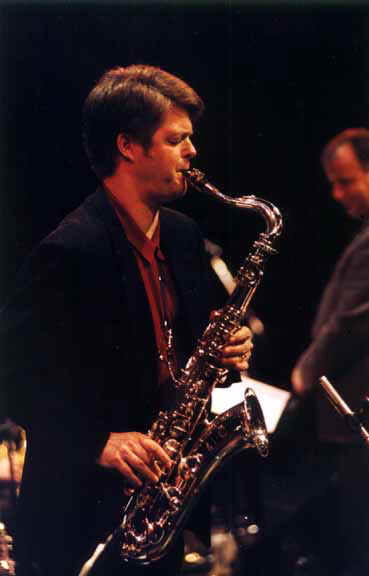
One of my first playing highlights was getting to solo in concert in Hugh's Concerto for Jazz Orchestra. I was very aware that I was following in Ross Taggart's size large footprints in this one. Hugh wanted a solo that would represent the forces of chaos and so it fell to me, I figured, because I'm from Vancouver where all those freaky free players live (now I am one of them). So I went for it, and in the thin air at Banff, my tenor had a huge muscular sound that I just can't get at sea level. At the dress rehearsal, as I walked back to my chair from the solo mike, Hugh told me that was the exact sort of solo he had always wanted for that spot. Ohhhh yeaahhh! That evening in concert, I did even better. The photo that is on this blog is that very solo, with Hugh looking on.

At that point I knew it was going to be very hard to go back to my Saturday morning rehearsal big band in Vancouver.

At lunch one day, came one of those innocuous comments. We were talking about graphic scores. Thanks to Coat Cooke and the annual New Orchestra Workshop series of improv workshops in Vancouver, I had recently had the opportunity to spend a little time with the fabulous bassist and composer Barry Guy, whose graphic scores are things of beauty to look at and stunning to listen to. Hugh said something to the effect of why don't you write something in that vein for us next year, and I said sure, why not. That proved to be another turning point.

Then there was the Maria Schneider experience, but that is best left for another installment.
What's the big deal about Banff?

I am not a fan of whiny blogs and upon rereading my initial post, I may have fallen into that trap somewhat.

The bottom line is that once I commit to go, I will do whatever it takes to get to Banff. Every year, despite the perceived obstacles, the artistic and personal payoff has been huge. Most of the people who have attended this program over its many years will tell you the same.

I now consider the challenges I mentioned yesterday to be an annual ordeal to endure, some sort of test of my determination to attend.

So what's the big deal with going there anyways?

Here's the official website.

The jazz programs in May come in two segments. The first is the 11-day Hugh Fraser Jazz Orchestra Workshop, with a 3-day composers residency tacked onto the front. Each year, Hugh will have one guest artist whose work includes progressive large ensemble writing.

After that comes the Banff International Workshop in Jazz and Creative Music, about 3 weeks of programs overseen by the great Dave Douglas, which is more focussed on individual and small combo playing. Dave has a much larger faculty of guest artists, all outstanding in their particular field. In very general terms, Hugh's program is more group-oriented, while Dave's is much more individual.

Some people take (or are accepted into) only one of the programs, some do both for a total of almost 5 weeks. In my opinion, that's the musical equivalent of getting a prolonged full body massage by the entire East German women's luge team - you will get hurt, and it won't be pretty. I've only done Hugh's program.

Hugh's philosophy towards the making of music is a very inclusive, community-oriented idea. The fabric of society (the universe, if he's in a cosmic mindset) is strengthened and enriched by the act of creating music that comes from the heart, and the more people who do so, the better. This sets a very welcoming tone for the entire duration of the workshop. All the musicians in the program have something to offer, regardless of their level of technical accomplishment.

That being said, it's a pretty damn fine bunch of players in the orchestra. Admission is by audition and often the competetion for a spot is fierce. I consider myself to be extremely fortunate and honoured to spend time with all of them.

And it's not all sitting in a circle singing Kumbaya. When it gets down to performance time, I've seen Hugh really crack down on the band if the the music is not being played at the highest level possible. As a musician, I am always challenged to push though barriers and exceed perceived limitations.

Without many of the pressures of regular daily life (day jobs, family, familiar gigs, bills, TV, etc.), it can be an emotional and musical crucible. After a number of days there, a person can start feeling pretty raw. Different people handle it in different ways. A very few simply leave, some dig in, some break down, some self-medicate to excess, some blossom. It's often unpredictable.

And that unpredictability is one of the things I treasure about going up there. I have no idea what is in store for me. I expect to play a lot of fabulous music with great, great musicians. I expect to work my ass off. I expect to have a blast and the occasional hangover. I expect to make new friends and connections, some of them possibly very significant in my life.

But after the program is all said and done for another year, I have always had some sort of epiphany, possibly about my music, or maybe about myself as a person. In the midst of the experience itself at Banff, it may be ecstatic, or it could be really shitty - I've had it both ways. It is always unexpected and often comes straight out of left field, and may not hit me until weeks or months afterward, then BAM, the old light bulb goes on.

It's one of the prime reasons I keep coming back to this workshop whenever I can. I know Hugh understands the powerful effects that this program has on of its participants. Once I've committed in my heart to go, I'd crawl over over broken glass to make sure it happens. Maybe that's one reason he has me back.

Monday, May 01, 2006

It always happens to me...

This is my fourth time to go to the Banff Centre to participate in the Hugh Fraser Jazz Orchestra Workshop and except for the first time round, I'm starting to recognize some familiar patterns.

1. I'm not ready. I always vow to practice like a fiend and have all my doubles up to scratch. Instead life imposes itself on my well-intended plans and my practice time evaporates. Do I have my Afro-Cuban chops down? Not even close. Well there's always time this week to cram. Yeah, right.

2. I don't know what horns I am supposed to play. I have the full gamut of saxophones from soprano to bass, also clarinet, bass clarinet, and flute. Hugh has never told me what to bring. I think my role is as a utility player - he'll slot me in once he sees the lineup of players that actually arrive there. But I'm not going to bring everything - as much as I like WestJet, I am always nervous about the safety of my horns, especially the bari and bass. I also want to bring a quantity of exotic hand percussion and my computer gear. It is impossible for me to travel light, especially to Banff. I'll give Hugh a call to get an idea of what he has in mind for me.

3. My car breaks down, contributing to pattern #4. Last week on the way home from a gig, the gear shift started going and within 24 hours, the car had nothing but 4th gear. We are a one-car family and we are dependent on our 16-year-old Volvo, but this time it was fatal, so we had to go get a new set of wheels last weekend.

4. We have some sort of financial crisis. I really don't know what this is all about. Each year, it's something else. Maybe tax time contributes to it, but something comes out of the blue to effectively drain every cent out of our bank accounts. I figure that those sly Swedes installed a sensor in my car that triggers a significant automotive breakdown once my bank balance rises to a certain amount.

This year, I thought I had it figured out. I sold off a bunch of my old musical gear on eBay and did really well, so there was my money to pay for Banff. Thanks to the car breaking down, that money is now gone. Fortunately, we have some money coming in at the start of the month, and I will just squeak in with my payments to the Banff Centre.

5. Finally, I am not getting enough sleep. Between worries about the car and the finances, and my eight-year-old daughter Cassandra piling into our bed every night, sleep has been at a premium, Just for added effect, I am gigging Friday night and won't get home until 2:00am and my flight to Calgary is at 7:00am. I'm chalking it up as preparation for the long hours I'll be putting in once I arrive there.