Tuesday, February 20, 2007

Kiwanis Jazz Festival 07

Well, it's Tuesday evening, the festival's finished and I am bagged. It has been very busy for the last few days. My brain capsized late this afternoon and I've been running on autopilot ever since.

A bit of background: The Kiwanis Music Festival is the largest series of annual student music festivals across the country. Starting in Toronto in the 1920s, it takes place in more than a dozen cities across the country. In this city in 1964, The Kiwanis Club of Vancouver took over the operation of a student festival that had been run by The Knights of Pythias. I mention this because the building the Knights had constructed as their lodge is now The Western Front. Today the Vancouver Kiwanis Music Festival has over 10,000 annual entrants, with seperate sub-festivals for jazz, concert band, choral and finally individual classical music categories. It's a huge event funded by the Kiwanis club and it gets little or no recognition in the media. Good news doesn't sell newspapers. Maybe we need an adjudicator to club a baby seal or something.

I'm mainly involved with the jazz segment. I am the titular chair of the event, but really there is a small committee that does the bulk of the work. Brenda Sleightholme is the administrator and Ken Osterreicher and Michelle Workman are the teacher coordinators from Argyle and Sutherland respectively. John Sharp superbly handles the tech details. We work in conjunction with Cap College, where we get great support from their administration and faculty. We have feature performances by Nitecap, their vocal jazz group , and also from the A Band. Tom Lee Music is a corporate sponsor and each year they are very generous in supplying keyboards, guitar and bass amps, also Taye drum kits for our main stage, warmup rooms and clinic rooms. Coastal Jazz & Blues sponsors a noontime presentation by a prominent local musician, or someone they may have in town for one of their events.

One the main functions of my duties is to ensure that things run on time. If things start getting behind schedule, adjudicators can burn out, teachers get impatient and our costs may start to rise if room rentals and tech crew run into overtime.

In this regard, we did very well, moreso today when we actually squeezed an extra band into the morning schedule. By moving one band on stage the moment the previous group vacated it, we were able to utilize the collective gaps in our 25-minute rotation. We were back to our original schedule remarkably fast. In all we had 11 vocal jazz groups, 40 stage bands and 1 combo entered in the festival, comprised of one elementary school and the rest either junior or senior high schoolers.

When I first got involved with Kiwanis in 1995, the festival was a fairly dry affair. The MC was retired high school principal (acutally very charming and funny at other times) who kept the youth firmly planted in their auditorium seats and well-shooshed. The adjudicators were more academics with music education credentials rather than working musicians. I became the MC the following year and the first thing I did was lighten up the atmosphere. Jazz is cool. Jazz is fun. It's full of self deprecating humour and practical jokes. Over the years I developed a repertoire jazz jokes, aimed at maligning as many different instruments as possible. "What's the difference between a chainsaw and a baritone sax? The exhaust." That sort of thing.

It's hard for some categories, like jazz singers, to find jokes that can be told in public to high school kids. I'm sure many of them know worse ones, but the teachers would flip out if I told them. There's too many trombone jokes. And then there's a definite lack of piano jokes, just a few. A couple of the best of those are in the unmentionable category, like the one that finishes off "Do you know there's a hole in your pants and your balls are hanging out?" "Know it? I wrote it!" Cam Ryga is a great one for walking by me as I am onstage and telling me the absolutely foulest joke, basically daring me to repeat it on mic. Anyways, I keep it relatively clean. Kids love to hate my jokes, then pester me for more. It keeps things rolling between schools and while the adjudicators are doing their thing.

As well, I harangue them to get out and support live music, keep playing after high school, and basically to make music part of their lives.

On the whole, I'd have to say this year's edition was a success. The changes we have made in the past year worked out well. We always find aspects to tighten up and refine, and this year is no different.

It was the general concensus that the overall quality of all of the participants this year, even the beginner bands, has risen in comparison with previous years. We did not have any achingly bad groups. I've got to give the teachers all the credit. Despite mounting external pressures, they continue to improve the quality of music education. They bring kids who are willing to learn and the teachers themselves seemed to be soaking up the information presented by our facilitators. Frankly, it's hard not to spend time in a room with guys like Hugh Fraser and not feel their infectuous energy. And they in turn get a boost from working with young musicians.

We always put on an evening showcase performance. In the past it's been the likes of VEJI, the Brad Turner Quartet and the Hugh Fraser Quintet. This year it was the NADEN band from CFB Esquimault. The fact that the Canadian Navy has several excellent bands across the country is largely unknown in Vancouver. It's more remarkable because these guys play over 200 gigs a year. They are full-time working musicians. We had them perform two years ago and three of our adjudicators, Cam Ryga, Brad Turner and Hugh Fraser sat in for a few numbers and shot the band into the stratosphere, truly a memorable show. The put on a solid performance for us this past Monday evening, very mainstream and most capably played.

But there was no question what was the highlight of the festival for many of us, and certainly for me. It was the A Band's one-hour set Tuesday noontime. They opened and closed with Thad Jones Mel Lewis Band charts, already more contemporary than anything we had heard the previous evening, and included pieces by Dave Holland and Maria Schneider. It was very exciting and the overflowing crowd was extremely enthusiastic.

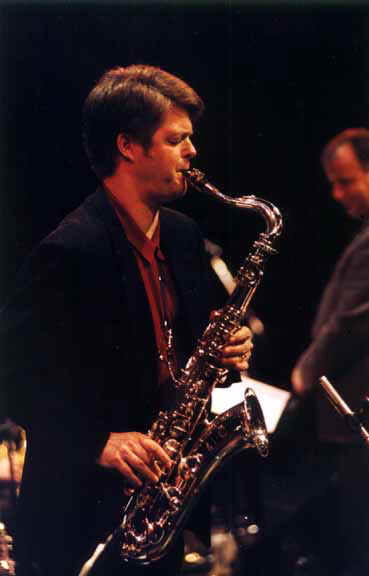
And in that performance was one of those moments that keeps me involved in the festival year after year. They had a high school student sub in on one of the tenor sax chairs. Director Réjean Marois had the eminently good musical instincts to feature the two tenor players trading off solos over an extended time. For the third time in three years, we got to hear real excitement, what the real potential of a big band is, when it really gets going and then the soloists stand up and blow their asses off. This time it was Evan Arntzen and Eli Bennett matching each other phrase for phase, showing yet again that they both are the real deal. I don't know if they've ever played toe to toe before, but the two of them were clearly having a great time onstage together. It was thrilling to see and hear.

Evan and Eli light it up with the A Band

It was one of those performances that will leave an indelible mark on many who saw the show. I hope it really inspired the kids in the audience and judging from the raucous ovation at the end, it did. My one regret was that Stan Karp, mentor to both of these fine young musicians, wasn't there to see it.

Sunday, February 18, 2007

Happy Birthday Stan!

Stan Karp has influenced an entire generation of saxophone players in this city, maybe two. There would be a very lengthy list of people, from the rawest young talent to established veterans on the scene, who have spent a little or a lot of time with him. Some of the latter would include Cory Weeds, Jon Bentley and Chad Makela. The young lions would have to include Evan Arntzen, Jamie Campbell, Tyler Summers and Eli Bennett. A full list would be a pretty big undertaking.

I've known guys who've moved to Vancouver just to study with Stan, also guys who insist on staying here when their careers may be better served to move somewhere else, again just to stay with Stan.

Stan is a bit of an enigma. Only a handful of people have ever seen him gig, despite the fact that he is a fantastic player. He's funny. He's cool. He's a gifted teacher, having learned from the very best - Bill Green, Buddy Collette, Joe Henderson. It was Joe that told him that he should teach and that's the path that he chose. I am convinced he could write the definitive book on how to play saxophone.

In over 10 years, I can't say that I've seen him give me a "bad" lesson, not when he had pneumonia, not when he had congestive heart failure. If the lessons were bad, it was not on his part, but mine. And on reflection, all of those ones were some of my most valuable. He never gives less than his very best if you walk through the door willing to learn and work at it. During some of my most important lessons, we never played a note.

Stan has a way of saying things that will stay with you forever. He has an encyclopedic knowledge of the saxophone. He is very intuitive with his teaching method, often zeroing in on what needs to be worked on, almost before you walk in the door. He constantly explores new angles, new avenues, new philosophies towards playing. He loves his students deeply. And he can outplay any of them.

He's turning 60 in a couple of weeks, and it was a major undertaking to pull of a surprise party. He thought he was coming to a gig by Eli Bennett, fresh back from his performances at the Grammy awards. Instead, there was a roomful of his longtime friends and students. He prides himself in always being in the know, but ringleaders Jenna and Bob got him this time.

Jerry Cooke put together a fine little R&B band. Jerry was sounding mighty fine, and was a deliberate choice because he wasn't ever a student of Stan's. The evening was meant to be fun (it was), not a jam session. The only other player to bring a horn was Eli, and everyone wanted to hear him. He played with a maturity way beyond his years and has come light years under Stan's guidance. He's a sweet guy and a great player at age 17.

Without a doubt, the most talked-about gift was a new horn from Sandro and the boys at Massullo Music. A KEYLESS SAXOPHONE! This is one strange-looking beast. No doubt Stan will be playing Donna Lee on it in a month, and will have developed a whole new teaching methodology within two.

Even though Stan's retiring this year from teaching at Cap College, he intends to be around for a long time, continuing to inspire, educate and love his students. I'm sure there were plenty more guys who couldn't make it last night because they were out gigging. We all love Stan. Certainly anyone who has been reading my blog will know my admiration for this guy. Things would most definitely have unfolded very differently had I not started studying with him back in October 1996. I can't imagine that I would have had many of the experiences that I've been writing here for the last nine months. I owe much of it to him.

Sunday, February 11, 2007

Song Room 6

The Song Room has rules.

<- Marguerite Witvoet

For the performers: The song must be an original composition, no more than 5 minutes in length. There can be no more than 3 performers, including the singer. The lyrics must be from a living Canadian writer. The theme of the evening is predetermined, and the song must have some relevance to that theme. There is a required dress rehearsal a couple of days prior and usually a sound check on the day of the show. Composers cannot participate in two consecutive Song Rooms.

For the audience: The cover charge is $10 plus a favourite food item, either savoury or sweet. There must be absolute silence during the performance. Engage the performers in conversation afterwards.

For the presenters: Open your home to up to a hundred people. Set up a meeting of the previous compsers and writers to determine a theme. Decide on six new composers. Organize rehearsals and performances to the minute. Make performers and audience feel welcome and a valued part of the process. Document the performances with a decent recording. Pay the performers 100% of the door proceeds. Make it a must-see happening. Repeat twice yearly.

Tom, David and Karen ->

Karen Matthews, Tom Cone and David Pay conceived of this series to promote the development of a library of new Canadian songs. To date they have premiered 65 new compositions involving over a hundred musicians. The musical disciplines range from contemporary classical to free improv, hip hop, folk and rock. Most of the performers are extremely accomplished, some are absolutely raw.

Since I composed The Deluge in collaboration with Stew Brinton, Alita Dupray and Dominique Brunchmann for Song Room 5, I couldn't participate again this time as a composer. I was happy to be an audience member for a change. And when I showed up with my trusty camera, I was pressed into being the official photographer for the evening.

This evening's theme was "indiscretion", a concept put forth by Stew at the Song Room 5 post-mortem.

The program opened up with a burlesque-style piece by Marguerite Witvoet in a sensual duet with her accordion named "Titano". Apparently this was quite a stretch from her more usual staid performances. It was a hoot.

Soressa Gardner and Karma Sohn ->

Next up was Soressa Gardner in your basic Gidget get-up, accompanied by accordion and cuica. Again it was fairly high in the camp factor. The text was based on letters to a fictional advice columnist, a cross between Dear Abbey and Dan Savage.


<- Kathryn Cernauskas and Heather Pawsey

The more "serious" content came from composer Leslie Uyeda and writer Brenda Brooks. They had stunning soprano Heather Pawsey sing about indescretion accompanied by cello and flute/bass flute. The piece was beautifully composed, with a degree of difficulty added by a last-minute substitution of cellists.

By this point in the program, it was getting pretty clear that the common conception of what constituted indescretion could be boiled down to "Men are pigs."

Tony Wilson, Billy Little and presenter Tom Cone ->

After a short break came a duet between the always-great Tony Wilson and distinguished poet Billy Little. He was in poor health and really could not sing, but nevertheless gave a very moving performance. He announced that his indiscretion would be attempting to sing. A born American, he had written a very blunt dissection of The Star Spangled Banner's lyrics entitled "We are Sick of War". I'm a little fuzzy on the details on this one as it was a last-minute addition and not in the written program.

<- Shanto, Carol and Rajinderpal

Carol Sawyer followed with a composition of hers with text by Rajinderpal Pal. The piece was based on director Krzyzstof Kieslowski's Dekalog, a ten-episode TV series, with each installment having been based upon one of the 10 Commandments. Carol called her piece Decalog 3, and it was certainly the most emotionally harrowing performance of the evening. Rajinderpal read his text while Carol and Shanto Bhattacharya on cello improvised on the emotional content of the words.

Kori Miyanishi, Leah Abramson and Shiho Mizumoto ->

The evening finished off with an Appalachian-style song played on two fiddles, he twist being that the the lyrical concept was a "murder-suicide hymn". Writer Leah Abramson and fiddler Kori Miyanishi sang in taut harmony. It was a very effective piece as the open tunings had a very primal effect.

As varied as the styles were, the songs all held together in a coherent set. It was a very satisfying night. The post-performance hang and nosh were equally as satisfying and by the end it was far too late to consider heading over to Ironworks or 1067. There was still talk about how effective our performance of The Deluge had been at the previous Song Room, and suggestions that I consider another collaboration with Alita for the next one.

Stew and I discussed it this morning and we were both of the opinion that we first need to know the theme for the June Song Room. That will lead to some concept for the text. We can then decide which singer would be the best to interpret it. With all of the great singers that we know in town, that's like letting a kid loose in a candy shop.

Saturday, February 10, 2007


Time Flies


<- Eyvind Kang - got my camera back!

I made it down to Ironworks for the last 2 sets of Friday night's performance. Time Flies is an annual series of concerts produced by Coastal Jazz and Blues wherein a number of notable improvisors from various locations around the world are brought together with some of Vancouver's finest. Over the course of three nights they are randomly selected to play in a number of small groupings. If there are any more rules than that, I'm not aware of them. For more, check out the CJBS website.

This format can have some unexpectedly surprising results but also runs the risk of becoming mundane if the musicians don't click. Risk is the key word. If the musicians play it safe, the results end up sounding safe. Going too far in the other direction risks wankery, so it's a delicate balance that is presented to an ever more discerning audience.


The major development for this year's event was the change of venue from the Western Front to Ironworks, certainly a great move in terms of atmosphere and intimacy. More than one person noted this was the coolest place in town, regrettably gaining that distinction due to the City's myopic closure of l'Espace. The performers and audience certainly seemed to react well to the new location.

<- Cor, Phil, Torsten

Afterwards, it was the general concensus that this has been the best Time Flies in recent years. The musicianship was uniformly outstanding. Local participants Peggy Lee and Torsten Muller certainly did not have to prove that they belonged with this group of highly-esteemed imports.
Cor, Peggy ->
Peggy in particular, seemed to own the stage as she has done in every outing of hers that I've ever seen. (I recall watching the London Composers Orchestra watch her open-mouthed while she soloed a couple years back.) Torsten was endlessly creative. Everyone else was similarly firing on all cylinders. Best of all, they connected together very deeply. They seemed to feed off the vibe in the room and the appreciation coming from the audience.

Having met most of the performers at Wednesday's workshops, and there were a good number of workshop participants present last night, I felt like we were rooting for our friends up there onstage. Everyone delivered. I had been at the workshops run by Eyvind Kang, John Butcher and Cor Fuhler and each of them were excellent.

I hadn't met Phil Minton as he spent Wednesday running a Feral Choir workshop at the Carnegie Centre. He was totally amazing. There were times when there were sounds emanating from the stage and we couldn't figure out who it was, only to determine it was Phil by watching small movements of his mouth. Again, it was a great example of how the human voice is versatile beyond belief, and how it can draw the audience into an improvisation.

Eyvind, Phil, John, Hasse Poulsen, Peggy ->
I know I'm lapsing into superlatives and not really describing what they did, but that is certainly part of the ephemeral nature of an improvised performance. Individually they were great, collectively they were greater. I can say no more.

Tonight the Song Room! Probably afterwards, I'll scoot down to Ironworks again for the final Time Flies set.

And since I have recovered from my cold, I'm also feeling much better about the Wednesday night performances. Again VCMI has proven to be a valuable experience for me.

Thursday, February 08, 2007

According to the experts

Apparently the singular of the word timpani is "kettle drum". Neither my Groves Dictionary or the Harvard Dictionary makes any distinction between one or a number of drums, but they did both point out that there was no "y" in the spelling, other than in incorrect common usage. Google didn't help, though I didn't persist with it for too long.

I guess I should have asked Giorgio yesterday.

Interestingly in the Harvard, I looked up "improvisation". There were about 8 inches of text, all devoted to historical references from the 17th century and leading up to the evolution of the cadenza. Only the very last sentence stated "An interesting revival of improvisation is in the jam session of contemporary jazz." So much for my chosen musical path.

This was only the second edition of this book, now over 30 years old. Hopefully it's been updated. To be fair, it did devote several pages to "jazz", coming up about a decade short of Ken Burns' summary.

I used to have an old music dictionary with a very disdainful, condescending and downright racist dismissal of jazz in it. I must have thrown it out.

The singular for timpani must be timpano, which as any film and food lover would remember was the object of Stanley Tucci's desire in the great film Big Night. It was an elaborate pasta dish in the shape of a drum, the ultimate achievement of Italian cuisine. That movie and Moonstruck made me want to be Italian, at least for a night. Goodfellas, not so much.
VCMI meets Time Flies

Wednesday was a full day indeed. I've been fighting the onset of a cold, and by the end of the day, I was dead tired. It was quite satisfying and the parts that weren't satisfying were informative. There's always something positive to be learned when situations don't work out as expected.

The day was structured in typical Vancouver Creative Music Institute fashion. There were a series of simultaneous workshops that went on throughout the day. You had to make choices, sometimes quite arbitrary, as which one to attend and which to miss. The workshops were led by the performers in this weekend's Time Flies series at Ironworks, and participants were VCMI alumni and VCC music students.

The first one of the day was a no-brainer, at least as far as the actual choice. Once we got into the room with Eyvind Kang, our brains were fully engaged. This was an easy decision for me because Eyvind played on Bill Frisell's Quartet album, one of my all-time desert island picks. He immediately launched us into a very philosophical and compelling discussion about improvised music, punctuated with short group improvisations. He continually encouraged us to go deeper into the music. Later in the day, the two of us talked about the challenges in strengthening the connections between the creative music communities in Seattle and Vancouver.

Next up for me was a larger ensemble situation co-led by John Butcher and Giorgio Magnanensi. I must admit that I am not really familiar with John's saxophone playing, but have read glowing reviews of some his previous performances here. I found him to be a very personable, down-to-earth sort of guy. Part of the workshop was given over to a conduction by Giorgio, something I've done many times and often enjoyed.

This time I was annoyed by some of the VCC students who were attending the workshop. The essence to conduction is keeping your eyes on the conductor at all times and following his every gesture. Another essential skill in improv is to pick your times to lay out and when to play, and then only do so with deliberate intention. So it started to get to me that some of these students just didn't get it. They kept their heads down, never followed a gesture and basically played nonstop for 20 minutes. I've seen this before with young players, and it's only with musical maturity and experience that they develop sharp improv skills. I guess I'm getting old and cranky because it was getting under my skin.

The third workshop was led by by Cor Fuhler from Holland. Though his English was excellent, I don't think we got his main point, and as a group we were unable to distinguish between making a gesture and making a more deliberate musical statement, save for doing it more loudly. For me, the best part about this exercise was that I played bass clarinet along with a couple of other much better players, Karen Davidson and Mike Dowler. I haven't had my bass clarinet out of the case since the ion Zoo gig in December, so it was gratifying to connect with them.

My feelings about outcome of the evening's performance were mixed.

The program was divided into two sets, the first being various groupings of VCMI alumni, each with a 6-minute slot. These groupings had been left up to the participants to arrange well in advance of this date. I had asked Jeff Younger and Russel Sholberg to do a trio thing. We've never really played together before in a small ensemble, but I have seen them both play quite often and I knew we'd be a good fit.

We were scheduled to go on first. So it was guitar, bass and me on soprano sax, aided by tympani. This was an idea I got from trumpeter Gord Allen during our time at VCMI in 2005. He played his trumpet into a floor tom to great effect. There was a large tympani onstage yesterday, so I commandeered it and played into it. It was a terrific effect, especially when playing the bottom notes of my horn and using the tympani head to totally or partially block the airflow, which created fantastic overtones, combining with the resonance of the drum. I thought it was an effective trio performance, and it was short and sweet.

("Tympani" is obviously plural - what's the singular? Tympano? Tympanum? Gotta check my Grove's.)

None of the groups that followed kept to the 6-minute guideline. A couple of them ran closer to 15 minutes, often with people choosing to ignore obvious timely endings. Rather, they just kept blowing. Every performance had something going for it, but my enjoyment was tempered by a growing annoyance at their inability to self-regulate. As a result the first set ran quite a bit over time and not surprisingly, we lost a fair bit of audience over the intermission.

The second set was a series of 15-minute performances comprising of the people involved in each of the workshops during the day. Again, every performance had something going for it and I was interested in seeing the results of the workshops that I didn't attend. Our performance for the Cor Fuhler workshop clearly reflected that we hadn't really got the message. It got bloody loud and ear-piercing at one point. I doubt that was the gist of the workshop.

Near the end of the night came the group from Eyvind's workshop, which I was really looking forward to. I thought things were going fairly well and I liked my playing. We came to an ending. But it didn't end. A VCC student who had sat in on the workshop had invited himself onstage for the piece. I was under the impression this was supposed to be a performance by VCMI alumni only, not the students. He decided it was time to feature himself on piano and so we lurched through a couple of more false endings while he continued to play. There was a bit of eyeball-rolling by some the rest of the people onstage.

Yes, I am getting old and grumpy. It probably wasn't all that bad. And maybe my low energy due to my cold didn't help. But I certainly have less tolerance for that sort of thing nowadays.

As I type this, I can't help but have more respect for teachers who work with these young musicians every year, full of unbridled enthusiasm. I just don't have the patience for it .

Tuesday, February 06, 2007

Green light effect

I miss my camera. I started having problems with it just after ion Zoo played The Cellar in December. A friend of Carol's who is a professional photographer was there and he offerred to take a few shots of us. He also changed all of the basic settings on the camera and afterwards, I couldn't get it back to the way I was used to having it. Then it took longer and longer for the camera to switch into ready mode when I turned it on.

There is an LED indicator that blinks as the camera starts up and reads the memory card, usually just a few seconds. In a short time, this was the only thing the camera would do, just blink. So I took it to the Nikon repair depot, quite near to my home. I was told it was the dreaded "green light effect", a design flaw with this model of camera, and that the whole metering system would have to be replaced. As I was listening to the prognosis, I couldn't help but notice the posted repair rates, which appeared to start with a $300 minimum. I was very relieved to hear that this was a factory recall and it would be done at no charge.

That was almost a month ago, and I am anxious to get it back. I've missed shooting a few of the Monday night series at The Cellar. There have been some really great sets lately and a couple of times I've seen some situations that would have made for great photos.

Last night I really enjoyed Sketches, comprising of Gord Grdina, Dan Gaucher and Neal Dhillon. I was digging Neal's control of his horn, his time and soft tone, very unusual in freer improv situations. Normally this is where sax players really let their tone open upn - certainly I'm one of those who pushes it to extremes and continually working on getting an even wider range of sounds out of the horn. Neal chooses to work in a very limited tonal palette, more in the Lee Konitz range, and really digs into the possibilities. And since he is also a highly accomplished tabla player, his sense of time and rhythm is impeccable. He and Gord and Dan navigated effortlessly through some deadly wicked time signatures. Neal dressed quite sharply and I wish I could have gotten a good photo of him.

I really like it when music is in a so-called odd (to whom?) time signature and it all sounds very organic, as opposed to a bunch of guys as much as shouting "Hey we're cool, we're playing in 13!" That sort of stuff quickly bores me.

During my first year at Banff, Maria Schnieder presented a few pieces in uncommon time signatures, an arrangement of Giant Step in 5/4. It was fast and really hard, an earlier arrangement of hers. I was happy that we decided not to perform that one. Rather, we did Hang Gliding, which is one of the most sublime pieces I've ever played, which just happened to be in 11. One of my first entries of this blog details my experience with that piece. It was one of the major turning points of my life.

By coincidence, yesterday I finished doing a lift of a Jeannette Lindstrom song called Leaf, with her blessing. On Sunday, I was surprised to find out that it was in 5/4 with the odd bar of 6 thrown in for effect. I've listened to the tune dozens of times, but I hadn't picked up on the time, as it all sounded very natural. I've liked the lyrics to this song, the fact that she wrote in here in BC and its mention of Robson St.

I've really enjoyed listening to Jeanette's In the Middle of this Riddle cd since I saw her a couple of times at last year's Jazz Festival. I just liked the sometimes startling clear tone of her voice, been interested in her deliberate choices of diction, English being a second language for her, and particularly liked Staffan Svensson's always understated and interesting trumpet playing.

So it's with a bit of regret that I had to change gears and start listening critically to this song, figuring out all of the bits that made it sound so good. It's like figuring out a magic trick, and having that experience of wonder surgically removed.

We're going to rehearse it tonight with the Wanda Nowicki Group. If we can make the song flow, we'll keep it, maybe record it. If we make it sound like we're thumping our chests about playing in 5, then I'll yank it. And god help anyone who pounds out that Take Five lick tonight. Years back we did a wedding where the groom requested that tune. I wrote an arrangement in 6, just to see if anyone was actually listening.

Tomorrow, a full plate of VCMI!

Monday, January 29, 2007

Dash it all

I was channel surfing a little while ago and briefly watched the most ridiculous piece of dialogue. It was a black and white British wartime-era melodrama, with two officers having a smoke in the Officers' Mess. Before I changed the channel again, the conversation went something like this:

"You know, Nigel, before all of this mess, I was an organist and a pretty good one, I daresay. I used to play organ at the cinema, but I always wanted to be a concert organist."

The other replied, "My dear boy, there are two types of people in this world, those who play organ at the cinema, and those who play Bach."

Tarantino it wasn't.

Later on, this stilted exchange got me thinking. I have the opportunity this year to play in many different groups and situations, more than ever before, and in a slew of differing styles. I could take on a lot of composing projects. Though few of them would be particularly lucrative (not a prime motivator in my musical life), most would be rewarding from a creative perspective, and I would definitely enjoy myself. I could have a chance to play many different instruments, and learn and improve on most of them.

On the other hand, I have a voice in my head (one of many) telling me to stick to one instrument, one style, and to really get proficient in that before having the audacity to take so much on. This is eminently sensible, yet also a convenient way to cop out, because one can never be simply "good enough", given the depth and tradition of jazz. Serious practice habits can easily breed perfectionist tendencies. Perfectionism gets in the way of success, always undermining it.

Some months ago I described myself as a musical generalist, a jack of all trades, master of none. I'm currently revisiting that concept, precisely because I now have all of these varied opportunities that I have been deliberately seeking out.

Coupled with that is my desire to increase my financial stability, which may entail a dayjob change in the near future. Uncertainty of what that may bring is making me think I shouldn't take so much on at this time. In fact, I've given a lot of thought as to how many of my current projects I'd be willing to give up, and which are non-negotiable. Could I pare it down to two? I could, with a great measure of regret for the others. One? I don't want to put myself in a position where I'd have to make such a choice. None? No way.

The next few weeks will be interesting as I work through all of this, hopefully finding some clarity along the way.

Wednesday, January 17, 2007

À propos of absolutely nothing musical...

I live in a joe lunchbucket neighbourhood in South Van. My daughter's school is a small, wonderful French immersion school. Everyone involved there knows it's a special place, something confirmed by former teachers I've run into who wish they were back there. It's a bit too far for us to walk every day, and involves crossing Knight Street, dicey at the best of times. When weather permits, we bike to and from school.

One of the kids at school occasionally gets driven to school in a Hummer. A bloody Hummer to get to elementary school! Christ on a pogo stick, is that really necessary, even if you're crossing Knight Street?

Sunday, January 14, 2007

Michael Brecker RIP

I've been pretty bummed out about hearing about his passing yesterday. I had to check it out several ways on the net just to make sure that it wasn't another malicious rumor. CBC reported it this morning, so that's official enough for me. But I still went to his website to see the absolute proof.

I've visited a terminal leukemia patient in the hospital. It's one hell of a way to go. I wouldn't wish it on anybody.

He'd been sick for two and a half years, and I hadn't heard anything for a while. The previous news I'd heard was that the experimental therapy had gone well and he was home practising. That was quite a few months ago, and just last week I thought about contacting Terry Deane for an update.

About a year ago I spent some time giving thought as to what constitutes a contemporary saxophone sound. There are so many styles and so many great players out there that I admire. Given my tastes that run to the avante garde, the field is even more wide open.

But for what I consider to be the mainstream, nobody embodied the contemporary tenor sax better than Mike Brecker. That he was a technichal master of the instrument is undeniable. He may well be the most influential saxophone player since Trane.

In the various student music festivals I've been involved with, I saw the emerging young lions announcing their arrival by playing (or trying to play) "that Brecker shit", not Bird, not Trane. It seemed to be to be the new benchmark.

I first heard him in the mid-seventies with The Brecker Brothers. As he started on his solo career ten years later, I bought his records. I didn't snap up everything that he released. At times the density and complexity of what he did overwhelmed me. Dexter was more my style for a number of years.

But one could not ignore the breadth of his work. Sometimes I preferred his work as a sideman, or an album where he didn't write all of the tunes. The McCoy Tyner cd Infinity remains one of my faves.

We added a couple of his tunes to our set lists, Midnight Voyage and El Nino, the former truly deserving to be considered a standard. I'd never play my Brecker shit with these tunes because frankly, I don't have any.

I bought a book of his transcriptions about a dozen years ago. I don't have a lot of books of transcriptions and the only one I've ever played cover to cover (with a nice slow metronome) was the Charlie Parker Omnibook. I had one of Dexter's (I could get the notes but never really get the feel) and one of Trane's (simply an exercise in humility). Brecker's book fell into the latter category. I pull those books out maybe once a year and they act as a benchmark. I generally find that I can play a bit more of the transcriptions, but the vast majority is beyond my grasp. That's really OK with me. I don't set out to try to imitate these guys, just to learn a bit more each time. I opened it up for about half an hour last night.

The thing about the Brecker transcription book is that it seems to be a vehicle for the enviable abilities of Carl Coan, the transcriber, who has gone to great lengths to notate what Brecker did in some of his solos. I really don't think that Mike really was planning on playing four groups of sixteeenth notes with a 13:2 ratio, or pickup notes of tenthtuplets or whatever. This is somebody elses scarily detailed interpretation of what he heard Brecker do. It makes it easy for an uninitiated player to miss the essence of Brecker's abilities, his command of the time, deep understanding of form and chord structure and the ability to impose shapes of notes, his own idiosyncratic lines, over the changes, regardless of what the changes were, yet they always sounded right.

And how many Guardala mouthpieces were sold to guys trying to emulate that unique sound? This of course fits into the category of "What reeds should I use to sound like Charlie Parker?"

I have often been of the opinion that Brecker's technical brilliance overpowered the emotional content of his playing. However in recent years, I felt that he was working on incorporating that more into his music. His last show here, at Cap College, was thrilling. That disease would probably have already been eating at his bone marrow.

Reading that he wrapped up his final recording project just two weeks ago, it will be most interesting to hear what he sounded like, with mortality clearly staring him in the eye.

Wednesday, January 10, 2007

Terminatrix

Last night my daughter came down with a mild version on the bug that Brian Nation has dubbed The Terminator. She didn't sleep well through the night, consequently neither did I. Then she was up early in the morning with the heaves - ahh, the joys of fatherhood.

I'm not so good at pulling those all-nighters as I used to be, so by late afternoon I was beat. I was stumbling to the bedroom for a nap and happened to look out the window. The outside light was pink due to the combination of a bit of a sunset effect and the street lights coming on. In my dazed state, I was sure I was looking at fresh cherry blossoms in the tree outside our bedroom window. Springtime already!

What a rube. Especially since I had been out earlier in the afternoon.

For any non-Vancouverites reading this, it was six inches of powder snow.

Thursday, January 04, 2007

Cross that one off...

This goal setting voodoo really does work! This evening I got an e-mail from Maria Schneider. Really. She doesn't want me in her band, nothing so trivial, she wants my financial contribution to her new cd project. I'm just happy her website marketing system remembered my name. Maybe a little quid pro quo would be in order. Perhaps I'll get my computer to ask her computer to fund my cd project.

Saturday, December 30, 2006

Resolution

For me, New Years Resolutions are promises to yourself meant to be broken, consequently I no longer make them. In 2006, the only Resolution that mattered to me was at Banff when I had the privilege of performing Hugh Fraser's arrangement of Part 2 of Love Supreme.

I am a believer in the use of goal-setting techniques in order to advance my progress as a musician. At the start of every year, I make lists of the various projects in which I am involved and then detail what I would like to see happen in the coming year. I also take a look at my ever-expanding collection of instruments and list what needs tweaking, repairing, replacing, whatever. Nothing is too trivial.

Everything ends up on a single sheet of paper, which I refer to several times during the year. I cross things off the list as they are done. I amuse myself at seeing what was important to me in January, but no longer relevant in July. Some things never get crossed off - too big, too small. Some things require a lot of TME (time, money or energy), others, sometimes surprisingly, just happen without effort. In the end, most of the individual listed items don't really matter, rather it's more important whether or not I've made progress in the year.

I start out by reading the previous year's list one last time. I am usually pleasantly surprised with how much I have accomplished. Generally, the ones that aren't crossed off don't cause much regret. I can either carry them over or dump them. I also have space to add the good things that did happen, even if they weren't on the list.

There are times when I am plagued by artistic sef-doubt and feel that I am stuck in a rut. Looking over the list reminds me just how much I've done.

It's important to have some ridiculously large things on the list, say "Get the call from Maria Schneider to sub in". That one is not really on my list, but maybe it should be. The odds of that happening are so minute as to be incalculable, but just having that in writing allows for the possiblility of other big things to happen. And they do.

It's essential to be very clear, sometimes the more detailed, the better. I might write a separate page on something very important, say if I were to be in the hunt for a new tenor sax, which thankfully I am not. A lack of detail may cause unexpected results. Last year I wrote down "new clarinet" to replace the loaner I've had for a few years. By the fall, I had to return the loaner and I did get a very nice clarinet on eBay, an alto clarinet. D'oh! Gotta be more specific on that one.

Ideally there should be more of the "being" and "doing" sort of goals, rather than the "having". That sets up a better state of mind for good things to happen, rather than the mere accumulation of more stuff.

There are actually very specific and detailed goal-setting systems out there, ones that require daily writing and recitals of lists and so on, but that's really too much work for me. I know people who do that and have amazing results. People into the personal development movement like to quote Emerson (Ralph Waldo, not Keith): "Once you have made a decision, the universe will conspire to make it happen." A quick Google search on that quote got a lot of hits on self-help sites, very few on scholarly Emerson sites, so it may be paraphrased or misattributed, or completely fabricated. Nevertheless, personal experience proves that it works for me. It may be a little bit woo-woo for some, but I'll take it.

I prefer one of Stan Karp's memorable sayings, which I believe came from his mentor Bill Green. "People often overestimate what they can do in one year and underestimate what they can do in ten." I interpret that as taking the path to slow and steady growth. My goal-setting technique is just one more tool to use in making that journey.


Note: I always feel like I'm writing this blog in a vacuum. It comes as a pleasant surprise when someone comments on a post, so I welcome any feedback. And if there is anyone hanging on every word that I write - get a life! - I neglected to hit the "publish post" button back on Dec 12th and now there is another entry in its proper place.

Thursday, December 14, 2006

Le fin de l'Espace

Late last evening I got a call to go down to l'Espace.

As many people know who read the vancouverjazz.com forum or the local papers, the city just closed down one of Vancouver's most unique and beautiful performance spaces. I received numerous requests for an on-line letter writing campaign to save this one-of-a-kind venue, but it was all for naught.

I first discovered the place several years ago when Viviane Houle started a short-lived Salon series, featuring songs by a wide stylistic range of local singers. The moment I walked in the door, I was in another place, certainly not Vancouver. Maybe Montréal, maybe Paris. The place was too damn cool, all this exposed brickwork and a giddy eclectic decor that was just so right. A lot of people spoke French, whether they could or not, and the wine and food flowed out of the kitchen area, and the music was transcendent.

As I understand it, Régis Painchaud and a friend discovered this place under the Granville St. bridge about 10 years ago. It was an early 20th century garage, probably one of the first places in the city where cars could be worked on. It was abandoned, full of ratshit and syringes and they were contracted to salvage building materials before the city demolished it. It was owned by the city, but rather than destroy it, these two realized the potential of this building and covertly renovated it.

By the time I discovered it, it was quietly being operated as a performance venue, a frequent film location, and a place to hold private receptions, including the COPE election-night party when Larry Campbell got elected as mayor. It stuck in the craw of of the beaurcrats at city hall that they had been outflanked. Régis had powerful political allies, particularly in Jim Green. They had a concept that the whole area around the l'Espace building could be converted to an artistic hub for the city. There was an ongoing battle between the politicos and the pencil-pushers to keep this place open.

I was involved with presenting a NOW Orchestra show there exactly three years ago when the city shut l'espace down. It was 5:00 the day of the show when Coat called me to tell me the gig was off. We all went down there for a drink as the musicians showed up for Coat to pay them for not playing. Régis had already been entered in negotiations with the city to do what was necessary to make the place legit. These talks dragged on for years and he was always optimistic that common sense would prevail. During this time, a very limited number events were allowed to happen.

When the NPA's Sam Sullivan stole the last civic election, the writing was on the wall. Any pet project of Jim Green's was doomed and the pencil-necks at the permits department saw their opportunity to move. They set conditions for Régis that could never be met, and no amount of public appeal would stop them.

I got down there at 11:00 pm, just an hour before the doors were to be locked forever. The first person I saw inside was a security guard sent by the city to ensure the deed was done. Régis was there, bone-tired but as gracious as ever, also Viviane Houle and Stefan Smulovitz. Régis had a few items left that he thought could be used at 1067, and some things he wanted to store there. The place was gutted to the walls, and there were a lot of boxes and various items strewn around the main floor. I loaded up my car with the things for 1067. At the end, just before midnight, Régis dug through a box to find a small gift for my daughter.

It was heartbreaking.

Tuesday, December 12, 2006

'Tis the season to be active

Somehow I missed posting this one back on Dec 12th.

I'm about midpoint in my stretch of daily gigs and so far so good. There is something to be said for performing this frequently, namely the benefits of connecting with your instrument in a way that doesn't happen when you're solely in the practice room.

The Christmas show I'm playing in wraps up next Monday night, by which time I'll probably be ready to be done with it. At present, it's enjoyable to do and there's always room for improvement. As Bill Green used to say, "If you know it so well, why doesn't it sound better?"

The show itself is an institution in Vancouver, this being its 40th year of production. In total, about 24,000 people see it each year, no mean feat. I feel this may not be the strongest production they've ever done, but I'll leave the critiques for the audience. For me, this whole experience is always a fascinating peek behind-the-scenes at the Christian music thing, which is a world unto itself. There are some very good musicians in the show and some great singers and I guess they can make a decent living on the circuit. It's something I just get a yearly glimpse at, being an unrepentant heathen and all.

Sprinkled through this performance schedule are my more regular gigs, which are the tonic for the Singing Christmas Tree. With Wanda, we have a number of corporate Christmas gigs, always welcome at this time of the year. Tomorrow Sharon Minemoto's subbing in with us, so that should be fun.

The improv rolls along as well. Last week's show for the NOW workshops at the Western Front went very well. After that, I went to the Cellar for the second set. The music was pretty strong but there was an unusually small crowd there. I attribute that partly to a fairly dry wording for the billing that the VCMI people insisted upon. Too bad - the players had worked hard to put on a good show.

<- Carol Sawyer, Clyde Reed & me at The Cellar Last night it was ion Zoo's turn and I was very pleased how this group continues to develop. Here's a photo from the show. This shot is indicative of one of the challenges photographing groups at the Cellar, that it's hard to include the pianist in the shot unless you shoot long from the back of the room, which often results in a flat looking picture. The other way is to stand at the bar and shoot over the pianist's shoulder, which generally means you will have a depth of field problem and certain players will be out of focus. Plus, the area on stage right is usually underlit, despit my efforts to aim more lights over there. So you end up composing shots just for the pianist, or for the rest of the band, which is what happened here. Too bad, because Lisa Miller was just great last night. <- over Lisa's shoulder

Tonight Carol and I are off to Chris Gestrin's to finish off the mixdown from our last performance at the Cellar. As I anticipated, there was so much good material from last night, that it will be very hard to resist the temptation to include some of those tracks on the cd. By coincidence, that's Chris's picture on the wall just in front of my bass clarinet.

Also on the recording front, we've secured the funding to take the Wanda Nowicki Group back in the studio - thanks, Joe! So we will switch back into that mode early in the new year - always a fun and educational experience.

This is a good sign that I'll start off the new year in a fairly active mode.

Monday, December 04, 2006

Busy again

Why is is that for many of us, for two months of the year, that things are crazy busy and the balance of the time musicians have to scramble for work? Every 6 months it seems that the universe is unfolding as it should. June and December are quite active for musicians at my level of the jazz food chain.

I'm gigging vitually every night for the first few weeks of December, sometimes twice a night. The New Year's Eve gig that we were working on just fell through a couple of days ago (cheap bastards won't shell out any more than a regular night) and I don't even mind not working that night.

Tonight is going to be an interesting one. When Coat and I were programming the NOW workshops, we didn't think twice about following our annual pattern of making the last Monday in the series as an evening performance. All well and good, except that we had previously scheduled this evening as a special night at The Cellar for alumni of the Vancouver Creative Music Institute. Then Coat got the call from Canada Council to sit on a jury all of this week. So now, not only had we programmed two events for the same night, but Coat would be out of town.

With some help from Dave Chokroun, who will hold the fort at The Cellar until I arrive, I will make things work. I will host the show and conduct the large ensemble at The Western Front, then bomb over to The Cellar to host the balance of the evening's proceedings and maybe get some playing in as well.

Well it beats sitting home and watching the TV, except for the bit that I posted on vancouverjazz.com today. There is a great musical segment at the end of Studio 60 on The Sunset Strip. Who are these guys?

Why does strange shit happen on the day I'm trying to get my jazz festival submissions in? This is a regular pattern over the last few years. Though I'd started early enough, it went down to the last day yet again. And just like previous years, that's the day my computer slowed down to a crawl and the printer wouldn't work right. Then on the way down to CJBS, I got a flat tire. Brand new tires, no apparent holes or leaks, just flat. I was redlining as I had to head out to a gig right after that.

On the plus side, doing a couple of private Christmas functions over the weekend has its benefits. The food was good and plentiful and people are all dressed up, though the latter is a particular disctraction for our piano player. If only all of our gigs had such hazards.

Another positive is the we've also almost finalized the Monday lineup for The Cellar for the first half of next year, right up to the jazz festival. I'm just nailing down the last couple of slots in Coat's absence. The lineup just keeps getting better and better and it's quite gratifying to see the depth of talent in this city and give them a chance to be heard.

Wednesday, November 15, 2006

Fallow

I can't recall having such a slow period for gigs in the last few years. Since joining forces with Wanda Nowicki a couple of years back, we've worked fairly steadily. Adding in ion Zoo and the other ventures that I get involved with, I'm usally as busy as I want to be. Since the Cage concert, though, work has been less plentiful.

With Wanda, we do a lot of restaurants, and in the last few months, many of the places have changed music policies or closed altogether. I know that change is just a fact of the restaurant business. In the past, we've always been able to find new venues, but at present, it's a bit of a challenge. In addition to her voice, one of Wanda's real talents is hustling gigs, so I am sure this is just a temporary situation.

In retrospect I was so busy in September and October that I didn't bother chasing down gigs for November. December is going to be a very busy month, so it all balances out.

So what do I do during the slow times? Nothing surprising here. I never seem to have enough practice time. As opposed to the young lions out there, the Evan Arntzens and Eli Bennetts of this world, I am on the slow track to learning the saxophone. Every day that I play, I feel that I get incrementally better, albeit microscopically. That's just the way it is for me. And Stan Karp will have a lifetime of things for me to work on.

On Sunday evenings, I have been part of a newly-created rehearsal ensemble that is reading through the extensive library of the NOW Orchestra. There is a lot of great music there that doesn't deserve to sit on the shelf. At some point, I will be able to bring out the three large ensemble pieces that I wrote for the Banff orchestra, also a good thing. And I get to play my alto sax, which otherwise sits in the case most of the time.

I have a couple of compositions in the works. Writing music is not something that I do on a regular basis. I need to have specific projects and deadlines. I am excited to have been asked to write something for LSB, an improvising string trio. I've been bouncing conceptual ideas for a graphic score around in my head and now it's time to get them on paper.

I've been doing the NOW workshops at the Western Front, something that I have helped to organize this year. I will be leading the final concert on the fourth of next month as Coat Cooke is off to Ottawa to sit on a Canada Council jury. My second composition in the works is for this concert, using a distillation of ideas gleaned from the workshop series.

The Monday evening series at The Cellar has been excellent. By the end of December, there will have been over 60 groups that will have participated this year. Only a handful of them have not been to my taste. Some have been absolutely outstanding, and this has been evidenced by the steadily growing audience numbers. I've had a small hand in the programming of this series and it's extremely heartening to see new talent appearing with such promise. Cat Toren's set last week was a fine example. I have been photographing most of the evenings for the past couple of months and some of my favourite shots are available for viewing on my page at flickr.com. Or click on the link at vancouverjazz.com. It's in the centre column under the Jazz Gallery heading.

I'm a rank amateur when it comes to photography. I liken it to performing on an instrument that I've never played before - sometimes the results are dubious, but the effort has been enjoyable. I've made a point of giving some prints to the bands and e-mailing all of my shots to the leaders. All of us have had too many gigs that have gone undocumented and later wish that there had been some record, audio or visual, of that time. We have worked at addressing that for the participants in this series.

And finally, there's the annual spate of submissions with their attendant deadlines. It often falls to me to put together the packages for the various groups that I am a part of, and this year I have my annual high hope of avoiding that last-minute panic to prepare and deliver them.

Sunday, October 22, 2006

Cagian interpenetrations

It's now Sunday at the end of a very long week and I am pooped.

Vancouver New Music presented a 4-day festival called Silence:John Cage. I was invited to be part of the large ensemble playing Atlas Elipticalis on the final evening. There were about 18 people in the group, a mix of the free improv crowd and UBC new music types. I'd played with many of them previously, so it was a comfortable fit for me. It was also very pleasant to be rehearsing at the Scotiabank Dance Centre, with floor-to-ceiling views from the 7th floor.

<- Giorgio Magnanensi and Marina Rosenfeld

It's always great to have a chance to work with VNM's artistic director, Giorgio Magnanensi, and he taught me an invaluable skill this time around, namely where to find the very best espresso in town and how to order it. He led the first day of rehearsals and it was fairly taxing, especially on him. Conducting this piece is akin to butoh dance, only slower.

<- Carol Sawyer, Clyde Reed and me at Rime

That night, I played a double-bill at Rime. The first set was with ion Zoo and it went very well. We are now a quartet, with Lisa Miller joining us whenever there is a piano available. Lisa is also part of the Atlas ensemble and at one point I became aware that she and I were both playing at that moment from a Cagian perspective. Afterwards, she confirmed that was the case. It was very cool to see that the Atlas experience had an immediate effect. It will be another tool in the ever-growing tool box.

The second set was with the Helsinki 8, just our third performance. The group has a lot of sonic possibilities, and gets stronger each time out. We did a set of mostly scored pieces, including my graphic score from Banff. It went well enough, though it did confirm my feelings that there is a much better piece hidden in there if I just use 10 per cent of the material. The gig was lightly attended. Blanche Norton, Rime's booker, told me that we were up against some stiff competition that night, particularly the Cage festival. That tickled me because half of the evening's performers were also in the festival. It was a fairly satisfying night on the whole, but getting in at 2:00 am just exhausted me the next day.

<- 7 of the Helsinki 8

Back bright and early at the Dance Centre, we were greeted by the guest artist for the Saturday performance. Marina Rosenfeld was described in this week's edition of Seattle's the Stranger as a "NY-based dub plate sorceress", and I thought the Georgia Strait had some flowery music writing... A quick visit to her website revealed her substantial credentials and she was indeed very stimulating to work with. She directed the group throughout the morning session, then had one-on-one discussions with each of us. She encouraged us to interpret Cage's performance notes to the word, and that definitely elevated the music as well as pushing our boundaries.

Many of the people in the ensemble remarked about how much work it took to perform the piece. Playing Cage requires a significant philosophical shift in one's approach to playing music, which in turn forces a pushing of technical boundaries. It just doesn't happen in a straight line, at least in the traditional sense.

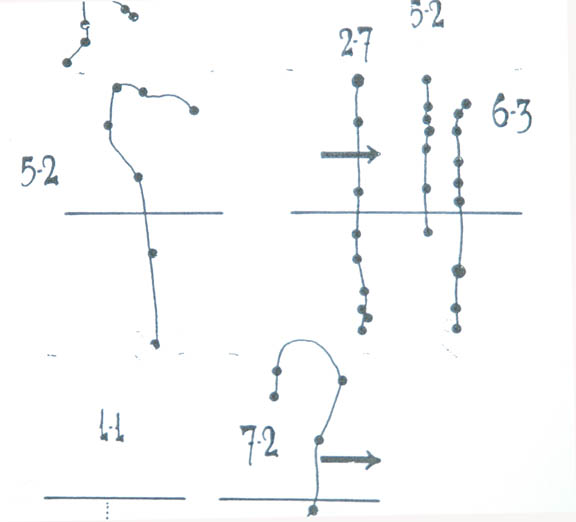
<- excerpt from Atlas Elipticalis percussion 1 part

Atlas Elipticalis was composed by Cage in 1961. The visual device for creating the score was achieved by overlaying star charts and the i ching on top of manuscript. All notes were to be played as quietly as possible, with as short a duration as possible unless otherwise indicated. There was to be no repeated notes, no "extraordinary" tone, no intention of melody and an avoidance of ego in the production of the sounds. Cage encouraged the idea of interpenetrations, wherein an instrumentalist produces two different sounds at the same time, say a bassist bowing with one hand and tapping the top with the other. Wind and string players were to play microtonally. Not all notes on the score had to be played. The list went on...

In short, rather than just a random production of sounds, musicians had to really think out how to play each and every note.

I had three sections where I had to play 70 notes or more in the space of 15 seconds. In other sections, maybe 9 notes in 2 minutes. And I decided to play just percussion. I had put together my rack with items that were often loud, had very long sustain and extraordinary sound quality, just the opposite of what Cage specified. So I had my work cut out for me. I had to find different ways of playing the rack, and ended up using bamboo skewers most of the time instead of sticks or mallets. Marina also wanted more "skins and wood", so I pulled whatever I could find out of my closet. It was quite a mixed collection, which I dubbed the "Randy Raine-Reusch Starter Kit".

In the end, the concert went very well in my opinion. Atlas Elipticalis was broken up into three sections. Other Cage compositions overlapped the various sections, often playing concurrently, yet they were distinctly different while occupying the same space. The audience and performers were intermingled and the audience was encouraged to move around to hear different sonic combinations. The program ended with two versions of the final composition John Cage wrote, first in the original piano/violin duet form, then with Marina doing a very musical and compelling version on her turntables, something Cage would have approved of, I'm sure.

<- RR-R Starter Kit

As I was listening to those pieces seated behind my percussion, I had an interesting experience. The performance hall was dark except for the starkly lit soloists. I was looking through my rack in Marina's direction, but she was obscured by one of my bronze sound plates. The way the lighting was, it appeared that the plate was a black square, not between the two of us, but rather in the black curtains on the opposite side of the recital hall. Logically, I knew where the plate was hanging, but the more I looked, the more it appeared to be a black hole, square in shape, on the other side of the room. This black hole was absorbing the images of everything directly in front of it, cutting off human forms at the neck or wherever. This effect lasted for what seemed several minutes as long as I was caught up in the music. When it came to a point that was less engrossing, the effect ended.

I understand that Cage enjoyed his shrooms, so he probably would have approved of this as well.

Saturday, October 14, 2006

Humbility

I think it's important for a musician to stretch his/her musical boundaries. Taken in the proper context, all experiences be they good or bad can enrich one's musical ability.

To that end, I've been doing some new things lately.

One of them was leading an improvisation workshop at the Western Front for the New Orchestra Workshop. I've participated in the workshops for years, now with thanks to Coat Cooke, it was time to teach one. I immediately broke my own prime directive for what I think constitutes a good workshop. I talked and encouraged discussion for a greater period of time than we played. The participants were are fairly experienced, and so I decided to spend time on a number of more advanced improv concepts and to share a number of the more important points that I had distilled over my years of taking these workshops. Since then, the feedback from most in attendance was positive, but next time I will work to severely limit the number of concepts that I present. As any regular reader of this blog can attest, I can go on for a bit.

Another one has been to start taking music classes at Ache Brasil. As a saxophone player, singing while playing is a great conceptual technique, but doesn't happen in the standard sense. So it is a very new thing for me to sing, in Portuguese no less, and play percussion at the same time. At this point in time, I can't really do it for any length of time without screwing up.

I can't help but think that this is one of the most ancient forms of music making, yet a considerable challenge for me. Capoeira music is very deeply connected to African music and operates on the same primal level. It's a relatively simple combination of percussion instruments and song that quickly becomes fairly complex, subtle and powerful.

No problem for a university educated jazz guy, like, we're supposed to be able to play everything, right? Riiiight...

I have no pretensions about where I fit in the local music scene, and consider myself relatively low on the food chain. Conversely, I have done a few things in my life at what I consider to be a pretty high musical level. Yet it really counts for very little when I walk in the door at Ache Brasil. I'm just another novice pandeiro player, and I'm quite happy to have it that way.

The next challenge this coming week is my participation in Vancouver New Music's presentation of John Cage's Atlas Ellipticalis. The performance is next Saturday night at the Scotiabank Dance Centre, part of a John Cage series being staged next week. It's a great privelege to be invited to play a composition by one of the icons of 20th century music. The score is a going to take a lot of work just to understand. We have 3 days of workshopping it into shape, led by Giorgio Magnanensi and visiting artist Marina Rosenfeld. Just to add to the degree of difficulty, I'll play percussion, maybe have one sax or clarinet ready if the music leads in that direction.

Here again, I expect to have my work cut out for me.

Finally, this coming Wednesday night at Rime, I will perform one set with ion Zoo, then a second set with Helsinki 8, where I'll conduct one of the pieces I wrote this year in Banff.

That's enough on my plate for now.

Sunday, October 08, 2006

Gratitude

This being Thanksgiving Day weekend and all, during a long drive out to a rehearsal, I had time to reflect on what I have been grateful for in my musical life.

It struck me that I may not be unique in being thankful to a long line of people who helped me develop what has become a life-long journey. I assume most musicians whose careers extend beyond their bedrooms don't develop in a vacuum.

If long acceptance speeches during awards shows or lengthy acknowledgements on an album cover are not your cup of tea, then you might as well skip this post. I figure I might as well do it here, where I control the horizontal and the vertical.

First and foremost, my friend and partner Clara has been my strongest supporter for almost 30 years. During all those years, she has had near unfailing support for my musical misadventures, often giving me wise advice and the occasional well-earned ass-kick.

My very first band teacher, Don MacKay, started me off on recorder in Grade 6 . I was considerably less thankful when I joined his marching band and he gave me a beat-up euphonium to play. My first-ever public performance was a Santa Claus parade and the mouthpiece froze to my lips. I switched to tenor sax the next day.

Band teachers: grades 7-9 Ken Elloway, grades 9-12 Jack Armitage - very patient and dedicated men, to say the least.

My music teacher in junior high school was Sister Margaret. A key day for me was late in my Grade 9 year when she asked the class who was going to continue on taking music in high school. Nobody put up their hand and she was so disappointed that she started to cry. I knew right away that she felt like she had failed in instilling her love of music to her students. I felt guilty, as I hadn't disliked her music class, so I signed up, no big deal, if it helped make her feel a bit better.

My high school music teacher and choir director turned out to be a significant influence on my life. Jim Farmer loved to show the interrelation of all of the arts through history, and was the person who introduced me to the likes of Stravinsky, Stockhausen, Penderecki and Cage. He taught us many useful skills like how to cheat on university listening tests, by memorizing the labels of the records. He staged big musical productions every year, sometimes too ambitious. He coped with them by sneaking a drink or two or three. He told us how being a music teacher meant a constant struggle with school administration for funding and recognition - how times haven't changed. The way he managed to be successful was be having a top-notch choir which always won its class in the music festivals, and to put on the crowd-pleasing big productions. He was only a few years older than us, and had plenty of human failings, but he was one of those very few great teachers that had a profound effect on hundreds of his students. That choir was my life in high school.

Jim's former university roommate was also a music teacher in the city school system. Brian May recommended me as his replacement in what became my first pro band. I had a union card before I graduated from high school.

In university, I am very thankful to have had a couple of great professors. Dr. Alfred Fischer was my composition prof. He was a student of George Crumb and pianist David Burge. Al really opened my eyes to the avante-garde. Marie McCarthy was a fabulous voice teacher and choral director. The rest of the faculty taught me many of the skills I was later to use in business - petty back-biting, bitter politics and general discord. The less I say about my sax prof and other voice prof, the better. This post is about gratitude.

I had also formed another band with some high school friends that was probably the only bona fide prog rock band in the Maritimes in the 70's. We kept at it for 5 years and gained some measure of success, and a fair amount of debt. Kurt Haughn, Kevin Atwood, Bob Atkinson, Bill Elliott and later Glenn Wright, Terry-David Désprés and Mike Connor were all a key part of my life. We were into that band as only a bunch of young fanatics could be. It broke my spirit when that band split up and I put my horns away for quite a few years.

I moved to Vancouver with Clara and forgot about music for many years. When I saw Urban Sax do their thing at Expo 86, I knew I had to play again.

Dave Quarin led the community big band that I stayed with for 16 years. He passed the band on to late great Ray Sikora, who inspired us to the end. Once Ray's health was no longer sufficient to lead the band, on the recommendation of bandmate Lorae Farrell, I called Robin Shier to see if he would take over, and he continues to lead it to this day. I learned volumes from these leaders, and the many great subs who directed over the years, as well as the workshops they organized with the likes of Jeff Hamilton and Bobby Shew.

Music stores have been very helpful for me and a couple have certainly seen a fair amount of my income, disposable or otherwise. Gerry Prussin has been there for me for years, and also now Sandro and the guys at Mussullo Music. Bob Syme has been my number one repair guy forever.

Bob introduced me to Stan Karp over ten years ago. I was looking for a new sax teacher and Bob told me there was only one guy to see and he would rock my world. Bob was right. Stan has been a great friend and teacher and has been the single reason why my playing has gotten to where it is today. I hope I'm still studying with him when I'm 100.

The other guys I've taken some lessons with: Dave Quarin, Graham Ord, Mike Allen, Cam Ryga.

I also owe a huge debt of gratitude to three of the stalwarts of the new music scene in Vancouver - Kate Hammett-Vaughan, Coat Cooke and Ron Samworth. They have been movers and shakers in this city for as long as I've lived here. I've known Kate since our days together at Acadia and she occupies a special place in my heart. Even after all of these years, she continue to knock me out with each new performance. Ron continues to create amazing and inspiring music in a variety of situations. His words of support to me are valued. I have done what I can to support the New Orchestra Workshop's endeavours, especially when Coat has had a heavier workload in recent years. In return, Coat's support of my musical ventures has been invaluable.

I can't begin to list what I've learned from them personally, and also from the things that they have been involved with, especially the New Orchestra Workshop and the NOW Orchestra. I took my first improv workshop with them 12 years ago. Last week, I taught my first one for them. The list of facilitators over the years (myself excluded) reads like a who's who of the world improvising scene. I got something from every session I attended. The individual members of the NOW Orchestra have all been inspiring to me.

Another one of those giant debts of gratitude is to Hugh Fraser and Lorae Farrell. The first call to Banff five years ago was one of the major turning points in my musical life. The guest artists - Maria Schneider, Kenny Wheeler and Chucho Valdes in particular - what can I say. Words fail. The friendships and musical relationships that have come out of that experience - Bill Mahar, Michelle Grégoire, Paul Rucker and Marianne Trudel to name but a few.

All of my bandmates past and present. Even the dinks (rare as they may have been) - I am a better person for playing with all of them. In particular, the people in my two main current groups: Wanda Nowicki, Chris Potter, Mark Bender, Carol Sawyer and Clyde Reed. I am blessed.

In previous posts, I've given shout-outs to guys who present music in Vancouver: Cory Weeds, Cem Zafir, Tom Cone and David Pay, guys like Raymon Torchinsky, also at The Cellar. Ken Pickering, Robert Kerr (now at VANOC), Carl Chinn and everyone at Coastal Jazz and Blues. People like Stefan Smulovitz and Jared Burrows who organize annual events for the improvising community. Julie Smith, for organizing the Vancouver Creative Music Institute with an illustrious faculty - George Lewis, Evan Parker, Marilyn Crispell, Mwata Bowden, Nicole Mitchell, François Houle, John Korsrud, Giorgio Magnanensi, et all.

Then there's Brian Nation at vancouverjazz.com. The contributors to the jazz forum and blogs, trolls excepted.

So many good friends that I've made. I've written about many of them in this blog, many more still unnamed. My community in high school was the musicians, and they continue to be so today.

Yeah, I'm bloody thankful. Time to eat turkey.